

Elon Musk Sets Ambitious SpaceX Revenue Target: $500 Billion by 2027 as Starlink Space Computers Prepare for Launch
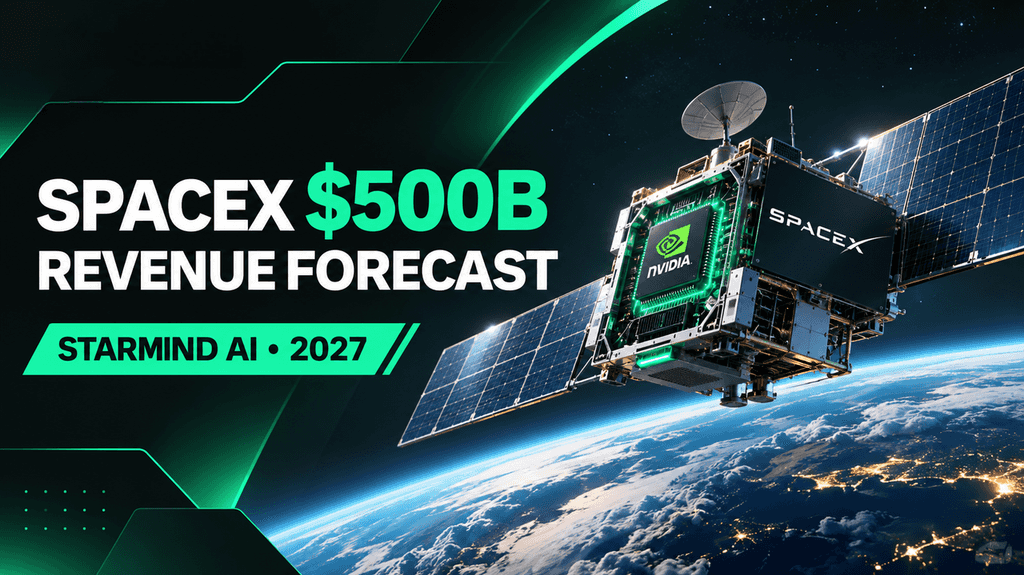
Elon Musk has set an ambitious $500 billion annualized revenue target for SpaceX by December 2027, outlining the forecast during the Baron Investment Conference on November 6, 2026. The projection comes as SpaceX expands its artificial intelligence infrastructure business and prepares Nvidia-powered Starmind space computers for potential launches in the third quarter of 2027. SpaceX reported $14.575 billion in revenue for Q3 2026, supported by growing AI computing operations and Starlink connectivity services. However, Musk's target represents a projected revenue run rate rather than confirmed annual sales, and achieving it will depend on sustained demand, substantial infrastructure investment and successful execution of the company's expansion plans.
Key Takeaways
-
SpaceX's $500 billion revenue target: Elon Musk forecasts an annualized revenue run rate exceeding $500 billion by December 2027, rather than $500 billion in full-year sales.
-
Strong quarterly financial growth: SpaceX reported $14.575 billion in Q3 2026 revenue, up approximately 161% year over year, with its Super Intelligence segment contributing about 52% of sales.
-
Nvidia-powered orbital AI computing: SpaceX is developing Starmind satellites using Nvidia's accelerated computing architecture, with initial launches tentatively planned for the third quarter of 2027.
-
Expanding AI infrastructure investment: SpaceX's proposed $24 billion Starbase power and supercomputing project could support additional computing capacity, subject to regulatory approvals and development requirements.
-
Significant financial and technical challenges: Achieving Musk's forecast depends on sustained AI demand, infrastructure deployment, operating efficiency and successful commercialization of orbital computing technology.
Elon Musk Targets $500 Billion in SpaceX Annualized Revenue by December 2027
Elon Musk has outlined an ambitious financial outlook for SpaceX, forecasting that the aerospace and artificial intelligence company could exceed a $500 billion annualized revenue run rate by December 2027. Speaking at the 33rd Baron Investment Conference, Musk linked the company's expected expansion to growing demand for AI computing infrastructure and its established satellite connectivity business. The projection follows SpaceX's strong third-quarter financial performance, although reaching the target would require revenue to increase substantially beyond its current reported level. The forecast also reflects how artificial intelligence is becoming an increasingly important part of SpaceX's long-term business strategy.
What Musk Revealed at the November 2026 Baron Investment Conference
During his discussion with investor Ron Baron, Musk said SpaceX was on track to exceed a $100 billion annualized revenue rate in December 2026, with the possibility of surpassing $500 billion by December 2027. He described the higher figure as his best estimate based on the company's expansion plans rather than a formal commitment. Musk also discussed a potential $1 trillion annualized revenue scenario but assigned it an approximate 2% likelihood, making clear that the upper estimate was substantially less probable than his central forecast. His comments reflected expectations that expanding AI computing capacity and related services could become major drivers of future revenue growth.
The distinction between annualized revenue and full-year sales is essential to understanding Musk's statement. An annualized revenue run rate estimates the sales a business would generate over 12 months if its revenue pace at a particular point continued. Consequently, reaching a $500 billion annualized rate in December 2027 would not mean SpaceX had generated $500 billion in revenue throughout 2027. Musk's forecast reflects expectations for rapid expansion in AI infrastructure and computing services, while the company's actual annual revenue will depend on contracts, computing capacity, utilization and recognized sales during the reporting period. This distinction is particularly important when comparing aggressive growth projections with quarterly earnings and full-year financial results.
SpaceX Q3 2026 Earnings Show Rapid Growth in AI and Starlink Revenue
SpaceX's financial results provide an important benchmark for evaluating Musk's forecast. According to its October 20, 2026 earnings release, the company generated $14.575 billion in third-quarter revenue, representing approximately 161% year-over-year growth from $5.576 billion in the same period of 2025. Net income reached $4.4 billion, while operating income totaled $2.791 billion. The results reflect the increasing contribution of artificial intelligence infrastructure alongside Starlink connectivity and launch operations. However, annualizing Q3 revenue produces approximately $58.3 billion, meaning Musk's December 2027 target is roughly 8.6 times the company's reported quarterly revenue pace. This substantial difference illustrates the scale of business expansion required to achieve the projected figure.
The company's third-quarter results reveal several important financial developments:
-
Super Intelligence: Revenue reached $7.56 billion, accounting for approximately 52% of total quarterly sales, supported by AI infrastructure, cloud services and software operations.
-
Starlink and Connectivity: Revenue totaled $5.248 billion, up approximately 69% year over year, supported by consumer subscriptions and enterprise and government demand.
-
Space operations: Revenue reached $1.767 billion, reflecting launch services and development activities.
-
Capital expenditure: SpaceX spent $19.593 billion during Q3 2026, illustrating the substantial infrastructure investment accompanying its expansion.
SpaceX and Nvidia Prepare Starmind AI Space Computers for 2027 Launches
SpaceX is advancing plans to deploy artificial intelligence computing systems in orbit through Starmind, a satellite-based infrastructure project developed in collaboration with Nvidia. The initiative aims to perform demanding AI workloads beyond traditional terrestrial data centers, using solar energy and high-speed satellite communications to transmit processed information back to Earth. During the November 6, 2026, Baron Investment Conference, Elon Musk indicated that initial Starmind computers could launch in 2027, potentially marking an important step toward commercial space-based AI infrastructure. However, the technology remains under development, and its long-term performance and economic viability have yet to be demonstrated at scale.
How Nvidia-Powered Starmind Satellites Could Bring AI Computing Into Orbit
Nvidia confirmed its collaboration with SpaceXAI on August 24, 2026, outlining plans to adapt its accelerated computing architecture for orbital operations. The first-generation Starmind AI satellite is designed around an optimized NVL72 system, combining high-performance processors, networking technologies and specialized software to support complex AI workloads. Unlike conventional Starlink satellites, which primarily provide communications services, Starmind satellites are intended to process information directly in space before transmitting results to Earth. This approach could eventually support AI inference, automated systems and other computationally intensive applications, although satellite reliability, thermal management and operating costs remain important engineering considerations.
SpaceX's published Starmind AI1 design outlines several technical features intended to support orbital computing:
-
Satellite dimensions: The proposed AI1 satellite measures approximately 30 meters in deployed height, with a 75-meter wingspan designed to accommodate substantial solar-power infrastructure.
-
Computing capacity: Each satellite is designed to support up to 250 kilowatts of peak computing power and approximately 175 kilowatts of average computing power.
-
Modular hardware: SpaceX says the system architecture can accommodate computing modules from different chip suppliers, potentially allowing hardware upgrades as AI processors evolve.
-
Power efficiency: The published design targets approximately 75 kilowatts of computing capacity per metric ton of spacecraft mass, an important consideration for launch economics.
These specifications represent SpaceX's proposed design rather than independently verified operational results. Delivering sustained computing performance in orbit will require reliable radiation protection, thermal regulation and communication systems, particularly as hardware becomes more powerful and densely integrated. Nvidia's involvement also connects the project to the broader semiconductor industry, although Nvidia (NVDA) stock performance reflects company-wide developments and market expectations rather than the commercial success of Starmind alone.
Why Starlink and Starship Are Essential to Space-Based AI Data Centers
The Starmind project relies on two existing SpaceX technologies: Starlink's satellite communication network and Starship's heavy-lift launch system. SpaceX plans to use high-bandwidth optical links to connect orbital computers with its broader Starlink constellation, allowing processed AI results to reach terrestrial users without requiring every computing satellite to maintain an independent ground connection. Meanwhile, solar panels could provide electrical power without relying on terrestrial electricity grids, potentially reducing some infrastructure constraints associated with conventional data centers. However, orbital computing introduces different challenges because heat must be removed through radiation rather than the air- or liquid-assisted cooling methods commonly used in ground facilities.
Starship is equally important because large orbital computing systems require substantial launch capacity. SpaceX's proposed fully reusable rocket architecture could reduce the cost of transporting heavy equipment into orbit if frequent launches and rapid reusability are demonstrated in practice. The company has also outlined plans for a Gigasat manufacturing facility in Bastrop, Texas, intended to support large-scale AI satellite production. Together, these developments form the proposed foundation for expanding orbital computing infrastructure, although manufacturing capacity, launch frequency, maintenance requirements and the cost of replacing aging satellites will determine whether the model becomes economically competitive with terrestrial alternatives.
Starmind Launch Timeline: Initial Deployments in 2027 and Potential Expansion Through 2029
At the November 2026 Baron Investment Conference, Musk estimated that the first Starmind space computers co-designed with Nvidia could begin launching during the third quarter of 2027. He described the timing as an estimate rather than a confirmed launch commitment and suggested that early deployments would proceed gradually before potentially expanding to significant volumes in 2028 and much larger volumes in 2029. Musk also said SpaceX had previously launched satellites carrying Nvidia graphics processors and a Google AI processor, which he understood to be operating successfully in orbit. Those reported experiments offer preliminary evidence that advanced processors can function in space, but they do not establish that a commercially scalable orbital AI data center has been achieved.
The projected schedule also reflects an evolving development strategy. Earlier SpaceX disclosures discussed commercial orbital AI deployment as early as 2028, while subsequent reporting indicated that initial technology demonstrations could take place during 2027. These milestones should be distinguished because launching experimental hardware, validating computing performance and operating a revenue-generating satellite network involve different technical and financial requirements. Progress will depend on successful spacecraft testing, sufficient launch capacity, reliable orbital communications and sustained demand for space-based processing services. Until those conditions are demonstrated, the proposed 2027–2029 deployment schedule remains an ambitious development outlook rather than an established commercial rollout.
Can SpaceX Reach Its $500 Billion Revenue Goal? AI Growth, Investment Risks and Future Outlook
SpaceX's ability to achieve its ambitious revenue forecast will depend on how effectively the company converts growing demand for artificial intelligence into sustainable commercial revenue. Beyond satellite connectivity and launch services, its expanding AI infrastructure business introduces opportunities in computing capacity, enterprise services and large-scale data processing. However, the financial outlook also depends on electricity availability, hardware investment, customer demand and the economics of operating increasingly complex infrastructure. The scale and timing of future growth remain uncertain, making operational progress and financial performance important measures of its long-term strategy.
AI Infrastructure Expansion, Starbase Investment and SpaceX's Growth Opportunities
SpaceX is expanding its terrestrial computing infrastructure alongside its longer-term orbital ambitions. On November 9, 2026, Reuters reported that the company was planning an estimated $24 billion gas-fired power plant and supercomputing facility in Starbase, Texas, according to a public hearing notice. The proposed investment would cover initial development phases, with potential expansion depending on future requirements. SpaceX has requested a property-tax abatement and an associated economic development agreement, which the Starbase City Commission is scheduled to consider on December 9, 2026. Developing dedicated electricity generation could help the company address power supply constraints affecting large AI data centers, although the project's final capacity, construction schedule and approval terms remain undisclosed.
The broader commercial opportunity depends on providing computing services at prices customers are willing to pay while managing equipment and operating expenses. SpaceX already supplies computing capacity to external technology companies, including Google and Anthropic, according to Reuters, providing an existing commercial foundation for further expansion. Growing demand for AI model training and inference could support additional infrastructure contracts, but revenue will depend on actual capacity utilization, contractual pricing and the ability to deliver reliable services. Competition from established cloud providers and other AI infrastructure developers could also influence pricing and profitability as more computing capacity becomes available. These factors make customer retention, recurring contracts and effective infrastructure management central to evaluating SpaceX's future growth potential.
Financial Challenges, Space Computing Risks and What Investors Should Watch
SpaceX faces substantial financial and operational challenges as it expands its computing business. According to its September 2026 quarterly filing, the company held approximately $51.3 billion in cash and cash equivalents and $38.6 billion in short-term marketable securities, providing significant financial resources for ongoing projects. Nevertheless, its expansion requires continued spending on processors, data centers, electricity generation, manufacturing facilities and technical development. The company has acknowledged that its AI business involves considerable investment and may experience periods of reduced profitability as infrastructure is built ahead of future demand. Strong revenue growth alone therefore does not establish whether new projects will generate attractive long-term returns.
Several upcoming developments could help investors assess the company's progress:
-
Financial guidance: SpaceX CFO Bret Johnsen projected first-quarter 2027 revenue between $33 billion and $37 billion, providing a measurable benchmark for future earnings reports.
-
AI computing utilization: Customer contracts, capacity deployment and revenue generated from available computing resources will help indicate whether infrastructure expansion is translating into commercial demand.
-
Regulatory decisions: Approvals for proposed facilities, environmental requirements and relevant space operations could influence investment schedules and operating costs.
-
Technology and competition: Improvements in AI hardware efficiency, changing electricity costs and new capacity from competing providers could affect the economics of SpaceX's computing services.
-
Market expectations: Future financial disclosures may influence how investors assess SpaceX's valuation relative to its growth prospects and broader AI infrastructure demand.
Analyst expectations provide another measure of the uncertainty surrounding SpaceX's financial outlook. In October 2026, JPMorgan reportedly projected approximately $254.1 billion in full-year 2027 revenue, while its year-end model suggested an annualized revenue pace below Musk's central estimate. The difference illustrates how assumptions about computing capacity, customer spending and infrastructure deployment can produce materially different financial forecasts. SpaceX's longer-term prospects will ultimately depend on turning infrastructure investment into reliable earnings and cash generation while maintaining operational efficiency across its expanding businesses. Until more financial results and commercial milestones become available, its ambitious growth outlook remains a projection rather than an assured outcome.
Conclusion
SpaceX's reported financial growth and expanding AI infrastructure operations provide a foundation for Elon Musk's ambitious revenue outlook, but the proposed $500 billion annualized target remains far beyond its demonstrated revenue pace. The Nvidia-backed Starmind initiative could eventually extend the company's computing business into orbit, creating opportunities beyond conventional satellite communications. However, the commercial viability of large-scale space-based AI infrastructure remains unproven, while significant capital requirements and engineering challenges could affect expansion plans.
The company's future performance will depend on converting computing capacity into sustained customer revenue while managing operating expenses and infrastructure investment. Upcoming financial disclosures, progress on the proposed Starbase development, and planned Starmind testing and launches will provide more concrete evidence of whether SpaceX can execute its strategy. For investors and industry observers, revenue growth, cash generation and verified operational milestones will be more meaningful measures of progress than the scale of Musk's projections alone.
FAQs
Does SpaceX's $500 billion revenue target represent its market valuation?
No. Elon Musk's $500 billion target refers to a projected annualized revenue run rate, not SpaceX's market capitalization, company valuation or net profit. These financial measures represent different aspects of a business, and the revenue forecast does not establish what SpaceX shares should be worth.
Is SpaceX already generating revenue from Starmind AI satellites?
As of November 10, 2026, SpaceX has not separately reported commercial revenue from operational Starmind satellites. Its existing Super Intelligence business generates revenue through AI infrastructure and related services, but that revenue should not be confused with earnings from the proposed orbital computing network.
Will Starmind replace traditional Starlink internet services?
No. Starmind is designed to complement Starlink rather than replace its broadband services. Starlink primarily provides internet connectivity, while Starmind aims to perform AI computations in orbit. The proposed system would use satellite communication links to transmit processed information to users and connected systems on Earth.
Could space-based AI computers operate more efficiently than terrestrial data centers?
Orbital AI computers could benefit from direct solar power and reduced reliance on terrestrial cooling infrastructure. However, their overall efficiency depends on spacecraft manufacturing, launch costs, thermal management, communication capacity and hardware lifespan. Commercial performance has not yet established whether orbital computing can consistently compete with ground-based facilities.
Disclaimer
This general market information, possibly from third-party, commercial, or sponsored sources, is provided for reference and educational purposes only and does not constitute financial or investment advice, an offer, solicitation, or guarantee. We disclaim liability for its accuracy, completeness, reliability, and any resulting losses. Investments/trading are risky; past performance doesn’t guarantee future results. Users should research, judge prudently, and take full responsibility. For further details, please consult KuCoin’s Terms of Use and Risk Disclosure.