

How Does PNC Bank's USDC Payment Pilot Convert Stablecoin Transactions Into Dollar Deposits?
Introduction
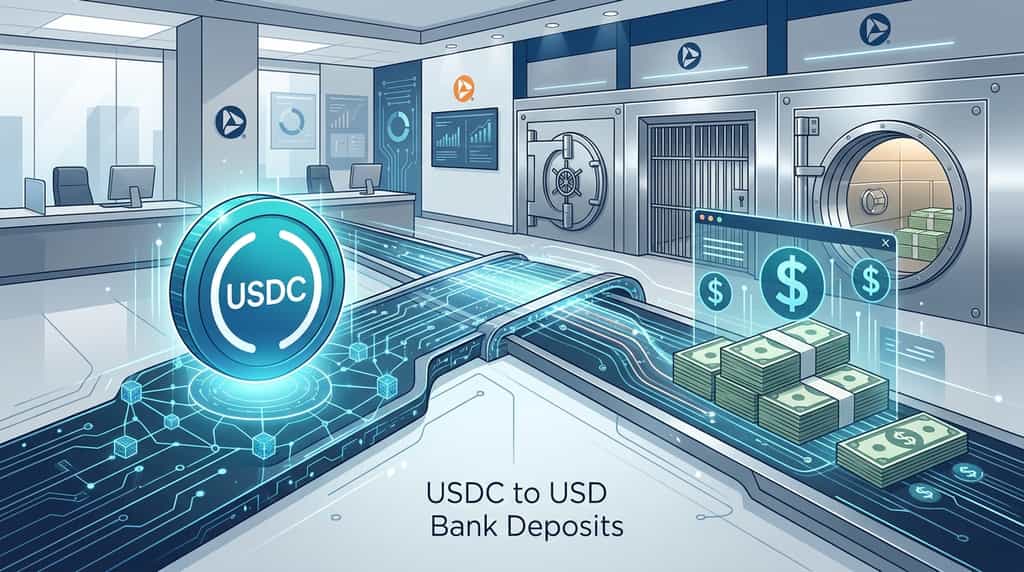
The convergence of traditional commercial banking and public blockchain rails has expanded significantly as major financial institutions test practical applications for digital currencies. PNC Bank recently initiated a pilot program enabling business customers to convert USD Coin (USDC) payments directly into traditional dollar-denominated bank deposits through a partnership with Coinbase. As corporate treasury departments explore faster settlement mechanisms and digital asset integration, understanding how stablecoin-to-fiat conversion infrastructure operates under existing banking frameworks is critical. This article examines the mechanics of PNC Bank’s USDC payment pilot, the regulatory and technological architecture supporting the conversion process, and what this development signifies for modern corporate banking.
Key Takeaways
-
Core Conclusion: PNC Bank initiated a pilot program allowing selected corporate customers to receive USDC payments and automatically settle them as traditional dollar deposits via Coinbase infrastructure.
-
Conversion Mechanism: The system bridges distributed ledger transactions with traditional automated clearinghouse (ACH) or wire settlement networks, converting stablecoin tokens into fiat balances upon receipt.
-
Corporate Treasury Impact: The pilot addresses traditional international settlement delays by allowing businesses to leverage blockchain rails for instantaneous cross-border or domestic transfers while maintaining traditional fiat accounting standards.
-
Regulatory Compliance: The integration operates under strict institutional compliance protocols, adhering to anti-money laundering (AML) and know-your-customer (KYC) standards enforced by both the bank and its digital asset infrastructure partners.
-
Current Status: As of November 2026, the pilot reflects a broader industry shift toward commercial bank adoption of regulated stablecoin rails for commercial settlement use cases.
How Does the PNC Bank USDC Payment Pilot Operate?
The technical workflow connecting blockchain-based stablecoin transfers to traditional commercial bank accounts involves a structured multi-step clearing and conversion process. When a corporate client initiates or receives a transaction using USDC, the infrastructure must bridge public distributed ledger networks with legacy core banking systems.
In traditional commercial banking, incoming wires or ACH transfers require multiple intermediary banking layers, often resulting in processing delays during weekends or after business hours. By integrating with digital asset service providers like Coinbase, financial institutions can accept tokenized dollar assets on-chain, verify transaction finality instantly, and execute an underlying fiat ledger adjustment.
The conversion pipeline typically follows a sequence designed to mitigate settlement risk:
-
Initiation: A counterparty sends USDC to an enterprise wallet address managed through institutional custody solutions linked to the banking partner.
-
Verification & Compliance: The smart contract transfer and sender details undergo automated compliance checks against sanctions lists and institutional risk parameters.
-
Liquidity Conversion: The received USDC tokens are processed through liquidity channels to redeem or exchange the digital tokens for fiat currency on a 1:1 basis.
-
Deposit Crediting: The equivalent dollar amount is credited directly into the corporate customer’s commercial checking or operating deposit account, updating the bank's general ledger.
What Technological Infrastructure Supports Stablecoin-to-Fiat Conversion?
Executing stablecoin-to-fiat conversions at an institutional scale requires robust application programming interfaces (APIs), secure custody architecture, and real-time ledger synchronization. Commercial banks cannot rely on consumer-grade wallet interfaces; instead, they require enterprise-grade infrastructure that interfaces seamlessly with core banking software.
The technical stack relies on several foundational components to ensure operational resilience and security:
-
Institutional Custody Solutions: Multi-party computation (MPC) key management systems secure digital assets while preventing single points of failure during transfer requests.
-
Real-Time API Bridges: Middleware connects public blockchain node validators directly to banking core systems, allowing instantaneous notification of on-chain events to trigger ledger adjustments.
-
Automated Reconciliation Engines: Software tools reconcile blockchain transaction hashes with traditional bank account statements, ensuring that token inflows match fiat ledger credits without manual intervention.
These technological layers eliminate the friction associated with manual treasury processing, enabling corporate finance teams to manage multi-currency liquidity with higher precision.
What Are the Practical Implications for Corporate Treasury Management?
The ability to convert digital asset payments directly into commercial bank deposits introduces significant operational shifts for corporate treasurers, CFOs, and treasury management service providers.
Traditional treasury workflows often require days to clear international invoices, tying up working capital and exposing firms to foreign exchange volatility. By utilizing stablecoin rails that settle into traditional deposits instantly, companies can achieve several operational advantages:
-
Accelerated Cash Flow: Eliminating settlement lag allows businesses to access working capital immediately upon transaction completion, improving liquidity forecasting.
-
Reduced Intermediary Costs: Cutting out multiple correspondent banks lowers wire fees and administrative overhead associated with cross-border payments.
-
Simplified Accounting Integration: Because the final state of the transaction is a standard dollar deposit, corporate accounting departments can record revenues and expenses using existing enterprise resource planning (ERP) systems without managing balance-sheet crypto volatility.
However, corporate adoption also requires careful evaluation of counterparty risks, smart contract vulnerabilities, and evolving accounting standards governing digital asset holdings.
FAQs
What is the primary objective of the PNC Bank USDC pilot?
The pilot is designed to test how commercial banking infrastructure can securely accept digital asset payments, convert them automatically, and settle them as traditional dollar deposits for business clients.
Are corporate customers holding crypto assets on their balance sheets in this pilot?
No. The conversion mechanism is designed to transform stablecoin payments into fiat currency immediately upon receipt, allowing corporate clients to receive traditional dollar deposits without holding digital tokens long-term.
Which partner assists PNC Bank with this digital asset infrastructure?
The pilot utilizes infrastructure provided by Coinbase to facilitate the technical integration between blockchain networks and traditional banking settlement systems.
How does instant stablecoin conversion impact settlement times?
Unlike traditional wire transfers or ACH cycles that can take hours or business days, blockchain-based settlement achieves finality in seconds, drastically reducing the time required to credit commercial accounts.
Does this pilot affect retail banking customers?
Current testing focuses specifically on corporate and institutional treasury management services rather than retail consumer checking or savings accounts.
Disclaimer
This general market information, possibly from third-party, commercial, or sponsored sources, is provided for reference and educational purposes only and does not constitute financial or investment advice, an offer, solicitation, or guarantee. We disclaim liability for its accuracy, completeness, reliability, and any resulting losses. Investments/trading are risky; past performance doesn’t guarantee future results. Users should research, judge prudently, and take full responsibility. For further details, please consult KuCoin’s Terms of Use and Risk Disclosure.