

Is Anthropic's 2026 IPO Worth Buying? $1.4 Trillion Valuation, $685 Billion Revenue Forecast, and AI Infrastructure Risks
Introduction
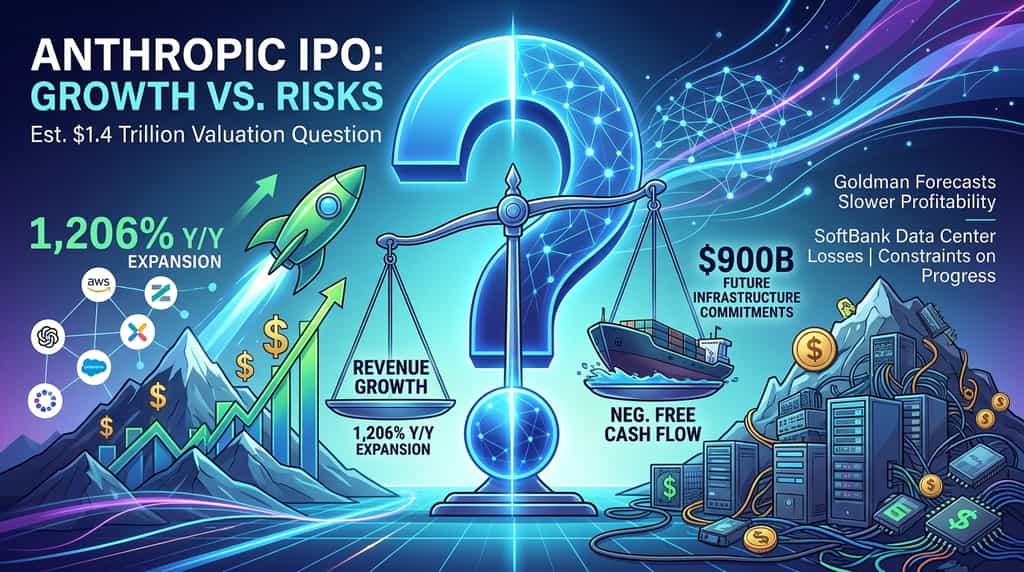
Anthropic's planned 2026 IPO presents investors with a difficult valuation question: does its extraordinary revenue growth justify a potential valuation of approximately $1.4 trillion, or does the offering already price in too much future success? The company has reported rapid commercial expansion, strong enterprise demand, and an annualized revenue run rate of approximately $81 billion. However, its IPO filing also reveals nearly $901 billion in future infrastructure and purchasing commitments, while Goldman Sachs analysts reportedly expect substantial cash outflows before the business reaches positive free cash flow in 2030.
The central issue is not whether AI has commercial potential. It is whether Anthropic can convert that potential into sustainable earnings and cash flow quickly enough to support its IPO valuation. The company's financial disclosures, SoftBank's recent data center losses, and Stanford's latest AI research all provide important context for evaluating that question.
Quick Answer: Is Anthropic's IPO Worth Buying?
There is not enough evidence to conclude that Anthropic's IPO is automatically attractive at its proposed valuation. Its growth is substantial, but the offering depends on ambitious revenue expectations and significant long-term infrastructure investment.
-
IPO pricing: Anthropic's November 10 SEC filing indicates a preliminary price range of $70-$78 per share.
-
Revenue growth: Revenue reached $33.2 billion in the first nine months of 2026, representing 1,206% year-over-year growth.
-
Infrastructure obligations: The company disclosed approximately $900.9 billion in aggregate purchase commitments and lease agreements, substantially all related to computing and infrastructure.
-
Profitability expectations: Goldman Sachs' reported forecast projects $685 billion in annual revenue by 2030, but also substantial operating losses and negative free cash flow before then.
-
Industry uncertainty: Stanford's 2026 AI100 report identifies growing constraints on data availability and computing costs, suggesting that future AI progress may depend increasingly on efficiency rather than simply expanding infrastructure.
For prospective investors, the key question is whether Anthropic can deliver the growth implied by its valuation while controlling the cost of computing capacity.
What Is Anthropic's Proposed IPO Valuation?
Anthropic's proposed IPO price range is $70-$78 per share, with the company applying to list its Class A common stock on the Nasdaq Global Select Market under the ticker ANT. According to its November 10, 2026, amended registration statement filed with the U.S. Securities and Exchange Commission (SEC), Anthropic plans to offer 825 million Class A shares, including shares sold by existing stockholders. The preliminary prospectus identifies $74 as the midpoint of the proposed price range.
The valuation figures circulating in the market require careful interpretation. Reports have described a fully diluted valuation of approximately $1.4 trillion at the upper end of the IPO price range, while narrower calculations excluding certain equity awards and options have produced figures closer to $1 trillion. These are different valuation conventions, not necessarily contradictory estimates.
This distinction also matters when comparing the proposed offering with earlier private-market valuations or reports suggesting a potential $2 trillion valuation. Private financing transactions can involve different share classes, investor rights, dilution assumptions, and transaction dates. A comparison between those figures and the IPO valuation is therefore not necessarily like-for-like.
The IPO filing also outlines a concurrent $26 billion private placement involving seven corporate investors, including Google, NVIDIA, AMD, Broadcom, Micron, Microsoft, and TSMC Partners. The shares are to be purchased at the IPO price, subject to the terms described in the filing.
This institutional participation provides evidence of strategic interest in Anthropic, but it does not independently establish that the public offering price represents fair value. For the underlying offering terms, see Anthropic's November 10, 2026, SEC registration statement.
Why Could Anthropic's Infrastructure Commitments Become a Major Risk?
Anthropic's infrastructure commitments are among the most important figures in its IPO disclosure. As of and subsequent to September 30, 2026, the company reported approximately $900.9 billion in aggregate purchase commitments and lease agreements, substantially all related to computing and infrastructure.
The filing provides several important details:
| Commitment Category | Disclosed Amount |
| Total committed spending | $900.9 billion |
| Expected before December 31, 2030 | $451.6 billion |
| Expected within the following 12 months | $70.7 billion |
| Remaining commitments | Mostly expected between 2031 and 2045 |
These figures represent contractual commitments and expected payments, not an immediate cash payment of the entire amount. Some arrangements also contain conditions, termination provisions, or other contractual details.
Nevertheless, the scale is significant. Anthropic must secure enough computing capacity to train and operate advanced models, serve enterprise customers, and support growing usage. This requires long-term planning involving data centers, chips, electricity, networking, and hosting services.
The financial risk arises when demand forecasts and infrastructure plans diverge.
If customer demand continues expanding, securing capacity in advance could help Anthropic maintain service availability and support future revenue. However, if demand grows more slowly than expected, model efficiency improves faster than anticipated, or computing capacity becomes less valuable, some commitments could become economically burdensome.
The company may still be required to pay for resources under certain agreements regardless of actual utilization. That creates a potential mismatch between contracted costs and revenue generated from the capacity.
Anthropic disclosed $146.6 billion in liquidity as of September 30, 2026, before accounting for the expected proceeds from the IPO and concurrent private placement. This provides a substantial financial cushion, but it should be evaluated against the scale and timing of future obligations.
The key issue is not simply whether Anthropic can raise enough capital. It is whether the infrastructure it has committed to can generate sufficient economic returns over its useful life.
What Does SoftBank's $7 Billion Quarterly Loss Reveal About AI Infrastructure Risks?
SoftBank Group reported a net loss of approximately 1.1 trillion yen, equivalent to around $7 billion, for the July-September 2026 quarter. A major component was a roughly $3.7 billion charge associated with equipment procurement for U.S. AI data center projects.
The loss followed changes to procurement plans at a subsidiary responsible for equipment arrangements. Some advance payments could not be recovered after the project requirements changed. The episode illustrates a broader risk in the AI infrastructure investment cycle: companies may commit substantial capital before project specifications, customer demand, and future capacity requirements are fully settled.
For the past several years, the AI industry has faced concerns about shortages of advanced chips, electricity, and data center capacity. Companies responded by securing equipment and manufacturing capacity well ahead of expected demand.
That approach can be rational when demand grows faster than supply. However, it also introduces financial exposure when plans change. SoftBank's experience highlights three risks:
-
Non-refundable advance payments: Some payments made to secure future capacity may not be recoverable if procurement plans change.
-
Contract adjustment costs: Changes to equipment specifications or delivery arrangements can create additional settlement expenses.
-
Financing pressure: Large infrastructure commitments can increase borrowing needs and financing costs, particularly when projects take longer to generate revenue.
This does not mean Anthropic will necessarily suffer the same losses. SoftBank's equipment procurement arrangements and Anthropic's contractual commitments are different. The comparison instead demonstrates why infrastructure spending should be assessed in terms of utilization, flexibility, financing costs, and expected returns.
For investors evaluating Anthropic, the important question is whether its large capacity commitments will support profitable customer growth or create financial pressure if demand assumptions change. SoftBank's official Q2 FY2026 earnings materials provide the company's primary financial reporting context.
What Could Anthropic's IPO Mean for NVIDIA and Other AI Infrastructure Stocks?
Anthropic's IPO is relevant beyond its own valuation because its infrastructure requirements connect it to a broader network of semiconductor manufacturers, cloud providers, data center operators, and technology companies.
If Anthropic's revenue continues expanding and its infrastructure commitments translate into productive capacity, demand for advanced computing hardware could remain substantial. However, the relationship between AI adoption and hardware suppliers' financial performance is not automatic.
Three possible developments deserve attention:
-
Continued infrastructure expansion: If AI usage grows rapidly and existing capacity becomes insufficient, demand for GPUs, memory, networking equipment, and data center construction could remain strong.
-
Improved computing efficiency: If models deliver better performance with fewer resources, the amount of hardware required for each unit of AI output could decline.
-
Slower infrastructure monetization: If enterprises take longer to convert AI experimentation into measurable business returns, infrastructure providers may face pressure on utilization and investment payback periods.
The third scenario is particularly important. AI companies can generate impressive revenue growth while their infrastructure suppliers still face uncertain returns on capital. The market must therefore distinguish between demand for AI services, demand for computing capacity, and the profitability of companies supplying that capacity.
Anthropic's IPO could become an important reference point for evaluating these relationships, but one company's public offering cannot establish the long-term value of the entire AI infrastructure sector.
Conclusion
Anthropic's 2026 IPO combines exceptional commercial growth with substantial financial and infrastructure commitments. Its reported revenue trajectory and enterprise adoption provide evidence that generative AI has developed into a significant commercial market. However, a potential valuation of approximately $1.4 trillion also requires investors to accept demanding assumptions about future revenue, profitability, and infrastructure utilization.
The reported Goldman Sachs forecast of $685 billion in annual revenue by 2030 offers an ambitious growth scenario, but the projected cash outflows before profitability demonstrate why revenue alone is insufficient to justify the valuation. SoftBank's recent equipment-related loss highlights the financial consequences of committing capital ahead of uncertain infrastructure demand, while Stanford's research suggests that AI development may increasingly depend on efficiency rather than computing scale alone.
Whether Anthropic's IPO is worth buying ultimately depends on the final offering valuation, the durability of its customer growth, its ability to manage infrastructure costs, and the speed at which revenue converts into sustainable free cash flow. These remain important uncertainties rather than settled outcomes.
FAQs
-
What is Anthropic's proposed IPO valuation in 2026?
Anthropic's proposed IPO price range is $70-$78 per share. Reports place its fully diluted valuation at approximately $1.4 trillion at the upper end of the range, although narrower valuation calculations may produce lower figures.
-
What is Goldman Sachs' revenue forecast for Anthropic in 2030?
Goldman Sachs analysts reportedly project approximately $685 billion in annual revenue by 2030. This is an analyst forecast rather than an official company target or guaranteed result.
-
How much has Anthropic committed to AI infrastructure spending?
Anthropic disclosed approximately $900.9 billion in aggregate purchase commitments and lease agreements, substantially all related to computing and infrastructure. Approximately $451.6 billion is expected to be incurred before the end of 2030.
Disclaimer
This general market information, possibly from third-party, commercial, or sponsored sources, is provided for reference and educational purposes only and does not constitute financial or investment advice, an offer, solicitation, or guarantee. We disclaim liability for its accuracy, completeness, reliability, and any resulting losses. Investments/trading are risky; past performance doesn’t guarantee future results. Users should research, judge prudently, and take full responsibility. For further details, please consult KuCoin’s Terms of Use and Risk Disclosure.