

Mira Launches Sterling AI Inference Service: How x402 and USDC Are Powering Pay-per-Use AI in November 2026
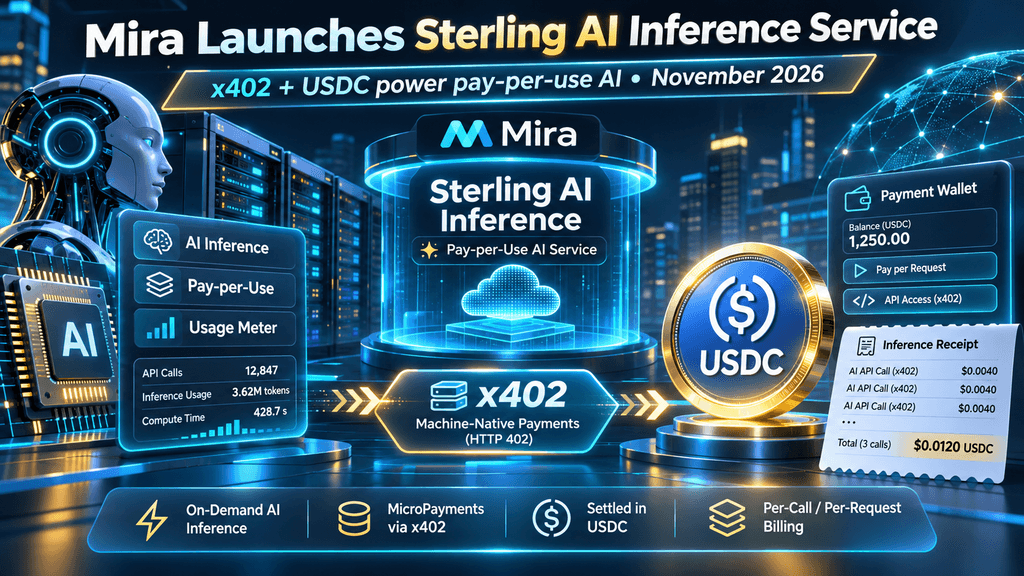
Mira Network Introduces Verified AI Inference With Transparent Provider Checks and USDC Payments
Mira Network launched Sterling as a beta AI inference service that routes requests only to providers that have passed ongoing automated verification. Developers select a model, receive one API key, and change the base URL in existing OpenAI-compatible code while credits are topped up in USDC through the x402 protocol or with MIRA tokens. The service currently covers Claude, GPT and Gemini models, with DeepSeek and GLM additions planned, and launch pricing sits as much as 50 percent below official list rates. Sterling runs five checks on every model-provider pair, model identity against a reference, tool-call behavior, parameter fidelity, silent failures, and advertised context length, then publishes scores and routes traffic exclusively to those that pass. A four-month Mira study of 189 API endpoints found 37 undisclosed model or service changes across 29 endpoints, illustrating the gap between the model name on an invoice and the system that actually answers.
Sterling therefore treats verification as infrastructure rather than an after-the-fact audit. Tests execute off the request path so latency remains comparable to ordinary inference, while public scores and evidence give buyers a measurable alternative to provider promises. The combination of verified routing and x402-settled USDC micropayments aligns the service with the broader machine-to-machine payment patterns already visible on Base and Solana, where the large majority of x402 volume settles in USDC. In the Mira Foundation’s same-day network update, Sterling is positioned as the first product in which the MIRA token performs daily work inside a paid inference service, converting the network’s verification thesis into a live endpoint at sterling.mira.network.
Key Takeaways
-
Sterling beta launched November 5, 2026, routing only to providers that pass continuous five-dimension checks.
-
Supports Claude, GPT and Gemini via one key and a base-URL change; DeepSeek and GLM coming.
-
Launch prices up to 50% below list; pay-as-you-go in USDC via x402 or MIRA.
-
Mira’s four-month scan of 189 endpoints found 37 undisclosed changes on 29 endpoints.
-
Public scores and off-path testing deliver verification without adding per-token latency.
-
x402 enables agent-native USDC micropayments, matching production machine-to-machine rails.
Continuous Provider Testing Addresses Silent Model Swaps
Sterling’s core design rests on scheduled, automated tests that Mira Network runs against every provider serving a given model. The five checks examine whether outputs match a reference snapshot of the claimed model, whether tool calls fire with parseable arguments at rates comparable to the reference, whether parameters such as max_tokens and temperature are applied as sent, whether empty or truncated replies arrive under a 200 OK status, and whether the full advertised context window is honored. Scores are published per model-provider pair together with the underlying request-response evidence, and routing prefers providers that currently pass. Mira has stated that tests run throughout the day; independent reports describe output testing roughly every two hours with scores refreshed on a similar cadence. Because the checks occur off the live request path, the developer’s observed latency stays close to standard API performance while the routing layer continuously incorporates the latest results. This approach directly targets the problem documented in Mira’s four-month examination of 189 endpoints, which recorded 37 undisclosed model or service changes across 29 endpoints, cases in which the system answering a request differed from the model named in the API contract. By making verification continuous and public rather than episodic, Sterling converts a known industry failure mode into an operational filter that buyers can inspect before traffic is sent.
The same public ledger of scores also creates accountability for the providers themselves. A provider that fails one or more dimensions is deprioritized, while those that consistently pass can display the associated marks. Anthropic’s recent writing on provable inference, referenced by Mira at launch, underscores that no independent party can currently verify what model actually answered a given call; Sterling’s design fills that gap with repeated, observable tests rather than cryptographic proofs attached to every token. In practice, a developer who needs reliable tool-calling behavior or a specific context length can consult the published scores and know that only providers meeting those thresholds will receive the request. The beta status means the tests themselves continue to accumulate data and improve reliability over successive runs, yet the routing rule is already active: traffic goes to verified providers first.
One-Key Integration Keeps Existing Code Intact
Accessing Sterling requires three steps that leave the bulk of an application unchanged. A developer creates a single API key that covers the currently supported models, adds prepaid credits, and updates the base URL of the existing OpenAI-compatible client to point at sterling.mira.network. The remainder of the request payload, model name, messages, tools, and parameters, stays identical, so migration effort is limited to the endpoint change and credit funding. At launch the key unlocks Claude, GPT and Gemini families; Mira has indicated that leading open models, including DeepSeek and GLM, will follow. Because the endpoint is OpenAI-compatible, the same libraries, SDKs, and agent frameworks already used against other providers continue to function without modification. This design choice reduces friction for teams that already maintain production code against multiple model vendors and simply want an additional layer that filters for verified supply.
Credits are added in either USDC settled through the x402 protocol or in MIRA tokens, after which usage is metered on a pay-as-you-go basis. During the launch window, pricing for the supported models is set as much as 50 percent below the corresponding official list rates, giving early users a concrete cost reduction while the verification layer is exercised at scale. The combination of a single key, an unchanged code path, and transparent credit accounting lets teams route a portion of production traffic through Sterling without rewriting authentication, retry logic, or observability stacks. As additional models are added, the same key and base URL continue to serve them, so the integration surface does not expand with catalog growth.
Five Public Checks Define What “Verified” Means
The verification scores page on Sterling enumerates the five dimensions with short operational definitions. Model identity compares provider outputs against a reference snapshot across repeated runs. Tool-call checks confirm that tools are invoked when the prompt requires them and that the returned arguments remain parseable. Parameter checks verify that settings such as max_tokens, stop sequences, and temperature are applied rather than ignored or overridden. Silent-failure detection flags cases in which an empty, truncated, or malformed response is returned with a success status. Context-window checks, run less frequently, confirm that the provider honors the length it advertises. Each score is accompanied by the sample of requests and responses that produced it, so an external observer can examine the evidence rather than accept a summary number. Providers that fail are routed last; those that pass receive traffic preferentially.
Because the scores are generated by automated tests rather than self-reporting, they capture behavioral differences that may not appear in static documentation. A provider may list a large context window yet truncate inputs in practice, or it may advertise full tool support yet return malformed arguments on a non-trivial fraction of calls. The public evidence trail lets buyers see the frequency of such deviations and decide whether the residual risk is acceptable. Mira has noted that the scores reflect observed behavior and do not attempt to diagnose root causes; reliability is expected to increase as the test suite accumulates more runs. For developers building agentic workflows that depend on consistent tool use or precise parameter control, the five-check filter supplies a measurable gate that is absent from ordinary multi-provider routers.
Launch Pricing and Credit Mechanics
Sterling’s commercial terms at launch emphasize simplicity and cost reduction. Users fund a credit balance with USDC via x402 or with MIRA, then draw down that balance according to actual token consumption. The introductory discount reaches 50 percent below list prices on the Claude, GPT and Gemini models currently offered. No monthly minimum or seat license is required; the model is pure pay-as-you-go once credits are present. This structure matches the usage patterns of AI agents and automated pipelines, which generate irregular request volumes that are poorly served by fixed subscription tiers. Because settlement occurs in USDC or MIRA, the credit top-up itself can be performed by an agent wallet without human intervention when x402 is used.
The discount is explicitly time-bound to the launch period, after which pricing is expected to move closer to prevailing market rates while the verification premium remains. Early volume therefore serves both to stress-test the routing layer and to give developers a lower-cost window in which to measure quality differences against their existing providers. Public reporting of scores alongside the price list lets a buyer compare the cost of a verified provider against the cost of an unverified one for the same nominal model, turning the verification data into a pricing input rather than a separate compliance exercise.
x402 Turns HTTP 402 into an Agent Payment Rail
x402 revives the long-reserved HTTP 402 Payment Required status code so that a server can quote a price inside an ordinary web response. The client, human or agent, signs a payment, typically a gasless USDC authorization on Base, attaches proof on the retry, and receives the resource once a facilitator settles the transfer. No account creation, stored card, or out-of-band checkout is required; the payment itself is the credential. The protocol is now governed by the x402 Foundation under the Linux Foundation, with premier members that include Coinbase, Circle, Cloudflare, Stripe, Visa, Mastercard, Google, AWS and others. Official SDKs exist for multiple languages, and adapters cover common web frameworks as well as the Model Context Protocol.
Production data show that the large majority of settled value moves in USDC. Across Base, Solana and other chains, trackers have recorded well over 100 million transactions and tens of millions of dollars in cumulative volume since mid-2025, with median tickets frequently in the cent range. Sterling’s use of x402 for credit top-ups therefore sits inside an already-operating machine-to-machine rail rather than inventing a new payment path. Agents that already hold USDC can fund inference spend programmatically, and the same facilitator infrastructure that settles other x402 services can clear Sterling credits.
USDC Dominance and Micropayment Economics
Nearly all measured x402 settlement value is denominated in USDC. Multiple independent analyses covering 2025–2026 place the USDC share above 98 percent, reflecting both Circle’s native issuance on Base and Solana and the asset’s deep liquidity for small transfers. Median payment sizes frequently fall between one and ten cents, well below the fixed fees of traditional card rails, which makes the protocol practical for per-call or per-token inference billing. Because settlement finality on Base is measured in seconds and gas costs are low, the economic friction of a micropayment is small enough that agents can treat it as an ordinary operational expense.
Sterling inherits these properties when users top up with USDC via x402. An agent can monitor its remaining credit balance, issue a top-up authorization when a threshold is crossed, and resume inference without waiting for human approval or invoice processing. The same characteristics that have made x402 the dominant open standard for agent payments, accountless, sub-dollar, USDC-native, now apply directly to verified model access. For teams running continuous agent loops, the ability to fund spend in the same asset and on the same rail used for other machine services reduces both treasury fragmentation and reconciliation overhead.
Public Scores Create an Inspectable Trust Layer
Every model-provider pair that Sterling routes carries a publicly visible score and the request-response samples that produced it. Buyers can therefore examine not only the aggregate number but the concrete failures that lowered it, tool calls that returned unparseable arguments, parameters that were ignored, or outputs that diverged from the reference model. Mira’s design choice to verify the provider continuously rather than attach a cryptographic proof to each individual token keeps the verification cost off the critical latency path. The Mira Foundation update published on launch day notes that this approach delivers verification at the same latency developers already experience, reflecting two years of operating a verification network.
The public ledger also supplies a shared reference point for the broader market. Providers that consistently pass can surface the scores as evidence of reliability; buyers can compare scores across vendors for the same nominal model before committing traffic. Because the evidence is open, third parties can audit the test methodology or re-run similar checks. In the beta phase the scores remain an assessment of observed behavior rather than a formal certification, yet the combination of repeated testing, public evidence, and preferential routing already converts verification from a private claim into a measurable, continuously updated property of the supply side.
MIRA Token Gains Direct Inference Utility
Sterling is the first Mira product in which the MIRA token is used to pay for a service that end users actually consume. Credits can be purchased with MIRA, after which the token is spent against verified inference. The Mira Foundation’s launch-day update explicitly frames this as the utility that earlier experiments could not achieve inside pure financial applications: a daily job inside a paid product. Holders or agents that already manage MIRA balances can therefore allocate the token directly to inference spend rather than converting to another asset first.
The dual-rail design, USDC via x402 or MIRA, lets users choose the asset that matches their treasury or agent wallet. For the network itself, sustained inference volume creates a recurring demand sink for the token that is tied to real usage rather than solely to staking or governance. As additional models are added and traffic grows, the fraction of spend denominated in MIRA will become an observable metric of the token’s role inside the verification layer Mira has built since 2024.
Industry Context of Undisclosed Provider Changes
Mira’s four-month study of 189 API endpoints documented 37 instances of undisclosed model or service changes across 29 endpoints. The findings quantify a problem that developers have reported anecdotally: a provider may substitute a smaller or differently configured model, alter tool-calling behavior, or reduce effective context length without updating documentation or notifying customers. Because most multi-provider routers select on price or availability alone, such substitutions can reach production traffic undetected until downstream failures appear. Sterling’s continuous checks and preferential routing are a direct response to that measured gap.
The same problem surface has prompted parallel work elsewhere. Anthropic’s recent discussion of provable inference acknowledges that independent verification of the answering model remains unavailable in ordinary API flows. By publishing scores and evidence, Sterling supplies one operational answer that does not require changes to the underlying model providers. The beta catalog is limited to Claude, GPT and Gemini precisely so that the verification machinery can be exercised against widely used commercial endpoints before broader open-model coverage is added.
Beta Roadmap and Near-Term Expansion
Sterling is explicitly in public beta. Scores continue to accumulate with each test cycle, and Mira has stated that reliability improves as the sample size grows. The immediate roadmap, outlined in the Mira Foundation update, centers on adding models and widening the set of providers under test. Leading open models are next, followed by expansion toward the roughly 200 endpoints that serve the current commercial catalog. Public scores for every routed pair are already live, so new models will appear with the same evidence trail from the first day they are offered.
December planning focuses on scale: more models, more providers, and continued refinement of the five checks. Because the endpoint remains OpenAI-compatible and the key surface does not change, existing integrations will automatically gain access to newly verified models without further code changes. The combination of an expanding catalog and continuously refreshed public scores is intended to turn Sterling from a launch-time filter into a standing verified supply layer for production inference.
Practical Developer Workflow and Observability
A typical integration begins with key creation and a credit top-up, followed by a base-URL swap in the existing client. Observability stacks that already capture request IDs, token counts, and latency continue to function because the response format is unchanged. Teams can therefore A/B a fraction of traffic against Sterling, compare quality and cost against their current providers, and expand the share once scores and empirical results align with requirements. The public verification page supplies an independent signal that can be consulted alongside internal metrics: a drop in tool-call success rate on one provider can be cross-checked against the published score for that model-provider pair.
Because routing decisions are driven by the latest test results, a provider that begins to fail a check is automatically deprioritized without requiring the developer to update configuration. This closed-loop behavior reduces the operational burden of maintaining allow-lists or manual provider health checks. For agent frameworks that already support dynamic base URLs or provider failover, Sterling can be inserted as an additional verified endpoint with minimal additional logic.
Alignment with Broader Agent Payment Patterns
Sterling’s use of x402 for USDC credit top-ups places verified inference on the same rail that already carries the majority of measured agent payments. Other services have adopted the same pattern for domain registrations, data APIs, and proxy bandwidth; Atom, for example, added an x402 checkout for AI-agent domain registrations settled in USDC on Base. The protocol’s Linux Foundation governance and multi-party membership reduce the risk that the payment layer itself is tied to a single vendor. As agent frameworks add native x402 support, the path from an agent’s decision to spend to a settled inference call shortens further.
The economic fit is direct. Inference is already billed per token or per call; x402 simply makes the settlement step programmable and accountless. When combined with Sterling’s verification filter, an agent can both pay for and receive a model that has been continuously tested against the five published dimensions. The result is a tighter loop between spend authorization, provider selection, and observable quality than is available when payment and verification remain separate systems.
FAQs
What models does Sterling support at launch?
Sterling’s public beta currently provides access to Claude, GPT and Gemini model families through a single API key. Developers change only the base URL of an OpenAI-compatible client and continue to specify the model name in the request body. Mira has stated that DeepSeek and GLM will be added next, followed by other leading open models. Because the key and endpoint remain constant, newly added models become available to existing integrations without further code changes. Pricing during the launch window is set as much as 50 percent below official list rates for the models that are live.
How often are providers tested?
Mira runs the five checks throughout the day and publishes updated scores. Independent reporting describes output testing approximately every two hours, with scores refreshed on a comparable cadence. Context-window verification is performed less frequently. All tests occur off the live request path, so they do not add latency to individual inference calls. Routing continuously incorporates the latest results, preferring providers that currently pass. The public scores page includes the timestamp of the most recent run and the evidence samples that produced each score.
Can I pay with USDC?
Yes. Credits can be added with USDC settled through the x402 protocol or with MIRA tokens. Once the balance is funded, usage is metered on a pay-as-you-go basis with no monthly minimum. x402 allows an agent wallet to authorize the top-up programmatically by responding to an HTTP 402 challenge, signing a USDC transfer (typically gasless on Base), and retrying. The large majority of production x402 volume already settles in USDC, so the same asset and facilitators used for other machine services can fund Sterling credits.
What problem does the four-month endpoint study quantify?
Mira examined 189 API endpoints over four months and recorded 37 undisclosed model or service changes across 29 of those endpoints. The changes included substitutions of model version, alterations in tool-calling behavior, and other deviations from the documented contract. Because ordinary routers select primarily on price or availability, such substitutions can reach production traffic. Sterling’s continuous five-check filter and preferential routing are designed to prevent unverified providers from receiving requests, addressing the gap the study measured.
Does verification add latency?
No material latency is added to the request path. The five checks run continuously in the background; routing simply reads the latest scores when a request arrives. The Mira Foundation update notes that this design delivers verification at the same latency developers already experience with ordinary inference. Cryptographic per-token proofs or re-execution on identical hardware would introduce delay; Sterling verifies the provider rather than each individual response, keeping the critical path unchanged.
Is Sterling production-ready?
Sterling is in public beta. The routing rule is active, scores are public, and the endpoint accepts live traffic, yet Mira describes the scores as an evolving assessment whose reliability increases with additional test runs. Teams can therefore route a portion of production traffic, compare results against existing providers, and expand usage as confidence in the scores grows. The OpenAI-compatible interface and single-key model minimize the operational risk of the initial integration.
Disclaimer: This general market information, possibly from third-party, commercial, or sponsored sources, is provided for reference and educational purposes only and does not constitute financial or investment advice, an offer, solicitation, or guarantee. We disclaim liability for its accuracy, completeness, reliability, and any resulting losses. Investments/trading are risky; past performance doesn’t guarantee future results. Users should research, judge prudently, and take full responsibility. For further details, please consult KuCoin’s Terms of Use and Risk Disclosure.