

Nvidia Faces New Scrutiny Over China Revenue Exposure as US Chip Export Bills Gain Momentum
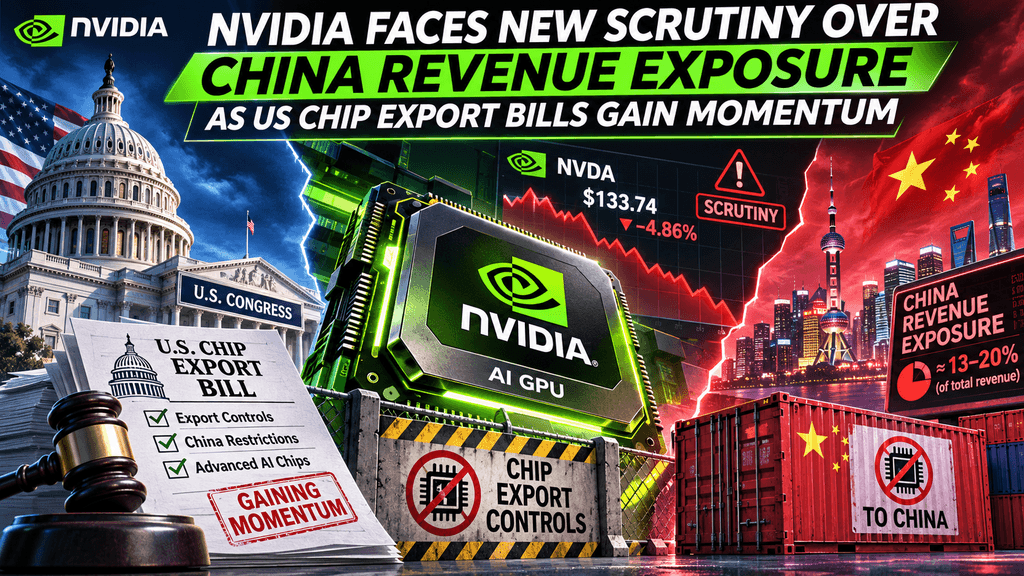
Nvidia is facing renewed scrutiny over its China business as US lawmakers push legislation that could tighten restrictions on advanced AI chip exports. On November 9, 2026, Senators Elizabeth Warren and Jim Banks called for stronger congressional action following reports concerning Nvidia CEO Jensen Huang's relationship with an individual suspected by US authorities of having links to Chinese intelligence. The controversy has added momentum to three legislative measures: the AI OVERWATCH Act, the Chip Security Act, and the MATCH Act, which are being considered as part of the fiscal 2027 National Defense Authorization Act (NDAA).
The potential impact extends beyond political controversy. Nvidia has already disclosed that its H200 shipments to China represent less than 1% of its recent Data Center revenue, while US and Chinese restrictions have effectively prevented it from competing broadly in China's data center computing market. If Congress expands export controls, Nvidia could face additional compliance costs, reduced market access, and stronger competition from domestic Chinese chipmakers. The key question is whether these developments will materially affect Nvidia's revenue growth and global AI leadership.
Key Takeaways
-
Three US legislative measures—the AI OVERWATCH Act, Chip Security Act, and MATCH Act—are gaining attention as Congress considers additional restrictions on advanced AI chip exports and semiconductor equipment.
-
Nvidia disclosed that H200 shipments to China accounted for less than 1% of its latest quarterly Data Center revenue, following restrictions imposed by both US and Chinese authorities.
-
The controversy surrounding Jensen Huang has prompted an independent board investigation and renewed congressional scrutiny, but no finding has established that Nvidia violated export control laws.
-
NVDA shares closed at $178.67 on November 9, down 4.27% for the session, amid regulatory concerns and broader market uncertainty.
-
Nvidia's November 17 earnings announcement will provide an important opportunity to assess its latest revenue performance, AI demand, and exposure to export restrictions.
Why Is Nvidia Facing New Congressional Scrutiny?
Nvidia's China export exposure has become a more prominent political issue following reports about CEO Jensen Huang's relationship with a former executive of Singapore-based Megaspeed International. On November 9, 2026, Democratic Senator Elizabeth Warren and Republican Senator Jim Banks issued a joint statement arguing that the reports increased national security concerns surrounding advanced AI chip exports. Their statement called for Congress to advance the AI OVERWATCH Act and urged the Commerce Department to address potential gaps in existing export controls. The development has connected a controversy involving Nvidia's leadership to a wider debate over US technology exports to China.
What Triggered the Latest Political Pressure?
The controversy follows reports that US authorities suspected Alice Huang, a former Megaspeed executive, of having links to Chinese intelligence. Megaspeed has also attracted scrutiny over concerns that its business activities could have helped China obtain advanced AI chips subject to US export restrictions. Jensen Huang acknowledged having a personal relationship with the individual and said he had been unfaithful to his wife. However, the personal relationship and the allegations concerning possible intelligence activities are separate matters, and neither establishes that Nvidia knowingly participated in an illegal chip transfer.
Nvidia's board announced on November 8 that independent directors, assisted by outside legal counsel, would conduct an investigation into whether Jensen Huang had been targeted by a foreign intelligence effort. The board stated that it had no reason to believe US national security or Nvidia's confidential information had been compromised. Huang expressed support for the investigation and committed to cooperating fully. Separately, Republican lawmakers in the House had requested a closed-door briefing from Huang, scheduled for November 18, concerning the allegations and Nvidia's security procedures.
Why Does This Matter for Nvidia's Export Business?
The issue matters because Nvidia sells technology that is central to advanced AI development, while US export rules restrict the transfer of certain high-performance chips to China and other designated destinations. Policymakers are concerned not only about direct exports but also about potential diversion through intermediaries, cloud infrastructure, and third-party customers. For Nvidia, the scrutiny could lead to closer examination of customer verification, distribution arrangements, end-user monitoring, and its compliance procedures.
A proposed shareholder class action filed on November 9 also accused Nvidia and Huang of failing to disclose information related to the controversy. These remain allegations in litigation, not established findings of wrongdoing. Nevertheless, the combination of congressional attention, an independent board investigation, and shareholder litigation has increased uncertainty around Nvidia's governance and China-related business relationships.
What Are the Three US Chip Export Bills?
The three legislative measures attracting attention are the AI OVERWATCH Act, the Chip Security Act, and the MATCH Act. Although they share the objective of strengthening controls over advanced semiconductor technology, they address different parts of the supply chain. The AI OVERWATCH Act focuses on government oversight of chip exports, the Chip Security Act addresses the security and verification of exported hardware, and the MATCH Act targets semiconductor manufacturing equipment through closer coordination with US allies. Reuters reported on November 9 that all three measures had advanced through relevant House committee proceedings and were part of discussions surrounding the Senate's fiscal 2027 defense authorization package. They have not all become law.
How Would the AI OVERWATCH Act Change Export Approvals?
The AI OVERWATCH Act, introduced by Senators Jim Banks and Elizabeth Warren in April 2026, seeks to codify and strengthen restrictions on exports of the most advanced AI chips to countries of concern. Its provisions would extend restrictions on the most powerful chips and require additional Commerce Department certification before certain less advanced chips could receive export approval.
The proposal also addresses individual export licensing. Rather than relying on broad approvals, it would require licenses for covered advanced chips being exported, re-exported, or transferred to designated destinations. The Commerce Department would also need to consider whether an export could undermine US supply, divert global foundry capacity, violate end-user restrictions, or facilitate unauthorized remote access. Senator Banks announced on July 14 that the legislation had been included in the Senate's fiscal 2027 NDAA process.
For Nvidia, the potential effect would be a more demanding approval environment for China-bound products. Even when a particular GPU falls below an existing technical threshold, the company could face additional scrutiny over the buyer, intended use, and availability of supply for US customers.
What Would the Chip Security Act and MATCH Act Do?
The Chip Security Act, introduced by Representatives Bill Huizenga and Bill Foster, focuses on mechanisms that help protect advanced integrated circuits from diversion, theft, and unauthorized use. Its proposed framework would require the Commerce Department to establish standards for chip security mechanisms, potentially including hardware, software, firmware, or physical safeguards. Location verification technology is a central element of the broader policy discussion. If implemented, such requirements could increase the technical and compliance responsibilities of chip designers, manufacturers, distributors, and customers.
The MATCH Act takes a different approach by targeting semiconductor manufacturing equipment. It seeks to strengthen coordination between the United States and allied countries over exports of equipment used to produce advanced chips. This matters because the semiconductor supply chain depends on technologies from the United States, the Netherlands, Japan, and other economies. Greater alignment among these countries could limit the ability of Chinese manufacturers to obtain certain advanced production tools through alternative suppliers.
The measures therefore address three connected areas: who can receive advanced AI chips, how exported chips can be secured and verified, and which manufacturing technologies can reach China. Their final effects will depend on the legislative language, implementing regulations, and whether the provisions survive negotiations over the NDAA.
How Much Revenue Is Nvidia Losing From China Restrictions?
Nvidia's direct China data center revenue exposure is currently much smaller than the country's potential market opportunity. In its fiscal 2027 second-quarter Form 10-Q, covering the quarter ended July 26, 2026, Nvidia disclosed that H200 shipments under the US licensing program represented less than 1% of Data Center revenue in its most recent quarter. The company also reported that it had been unable to sell all the H200 products covered by US licenses because sales were restricted by Chinese authorities. This distinction is important: the immediate revenue contribution is limited, but the longer-term commercial opportunity remains significant.
What Happened to Nvidia's H200 and H20 China Sales?
The H200 situation illustrates how export controls and import restrictions can operate simultaneously. Beginning in February 2026, the US government granted licenses allowing limited H200 shipments to specific China-based customers. However, Chinese restrictions prevented Nvidia from completing all the sales for which it had received US authorization. During the first half of fiscal 2027, Nvidia recorded a $400 million charge associated with excess H200 inventory and purchase obligations as demand for these products diminished.
The permitted H200 shipments also face additional conditions. Nvidia disclosed that the products must undergo inspection in the United States before shipment and are subject to a 25% tariff upon importation into the United States. The company said it had been unable to pass this tariff cost on to customers. Earlier restrictions on H20 products had also resulted in a $4.5 billion inventory-related charge in the first quarter of fiscal 2026.
These figures demonstrate that export restrictions can affect Nvidia through more than lost sales. Licensing uncertainty can create excess inventory, complicate production planning, increase compliance expenses, and reduce the company's ability to allocate manufacturing capacity efficiently.
Is China Still a Significant Long-Term Market Opportunity?
Nvidia stated in its second-quarter filing that, as of July 26, 2026, it was effectively foreclosed from competing in China's data center computing market with products that could satisfy both US and Chinese regulatory requirements. The company could still ship certain uncontrolled products, including gaming and workstation GPUs, but its access to the advanced data center market was severely constrained.
Nvidia also warned that the absence of a competitive data center product in China could allow domestic competitors to develop larger customer and developer ecosystems. This is a strategic concern because the company's competitive advantage depends not only on GPU performance but also on CUDA software, networking, systems integration, and developer adoption.
It is therefore misleading to describe China's impact as a simple percentage of Nvidia's current revenue. The company does not disclose a single figure that captures all the potential revenue it could generate if advanced data center sales were fully available. Investors should distinguish actual China shipments, inventory charges, and lost market opportunities. The less-than-1% H200 shipment figure describes recent realized shipments relative to Data Center revenue; it does not measure the size of the Chinese AI computing market or Nvidia's total potential exposure.
How Could New Export Laws Affect Nvidia's Global AI Business?
The potential impact of tighter US chip export controls extends beyond China-bound shipments. New requirements could influence Nvidia's customer relationships, distribution channels, supply-chain planning, and competitive position in other international markets. If the legislation expands licensing requirements or introduces more extensive chip verification obligations, Nvidia may need to invest in additional compliance infrastructure and coordinate more closely with distributors, cloud providers, and end users.
Could Chip Tracking Increase Nvidia's Compliance Costs?
The Chip Security Act could require additional technical safeguards for covered integrated circuits. Depending on the final standards, companies may need to provide stronger assurances about chip identity, location, ownership, and authorized use. Such mechanisms could make unauthorized transfers easier to detect, but they could also introduce implementation costs and operational complexity.
For Nvidia, the challenge would involve managing a global distribution network that includes original equipment manufacturers, server providers, cloud companies, and enterprise customers. A chip may be sold to an authorized customer and subsequently integrated into a larger system or deployed through a cloud service. Verifying the final destination and use can therefore require more than checking the initial shipping address.
Nvidia has previously warned in its SEC filings that changing export rules can disrupt distribution channels, increase compliance burdens, create inventory risks, and encourage customers to choose alternative suppliers. The company also noted that restrictions may affect demand outside China if international customers redesign products to avoid potential licensing complications.
Could Chinese Chipmakers Benefit From Further Restrictions?
Tighter controls could create additional opportunities for Chinese semiconductor companies, including Huawei and Cambricon. If domestic AI developers cannot access certain Nvidia products, they may increase purchases from local suppliers or invest more heavily in proprietary chip architectures. This could support the growth of China's domestic AI computing ecosystem.
However, replacing Nvidia involves more than manufacturing a GPU with comparable theoretical computing performance. Developers also consider memory bandwidth, networking, software compatibility, compiler support, system reliability, and access to technical assistance. Nvidia's CUDA ecosystem remains a significant competitive advantage, and domestic alternatives may require time and investment to achieve comparable adoption across different workloads.
The long-term effect is therefore likely to depend on the interaction between hardware restrictions and software ecosystem development. Export controls could reduce Nvidia's immediate access to certain customers while encouraging competitors to improve their products and developer communities. This is a strategic risk even if the direct revenue impact remains limited in the near term.
Why Did Nvidia Stock Fall in November 2026?
Nvidia shares experienced significant volatility in early November as investors assessed AI-sector valuations, China export restrictions, and the controversy surrounding Jensen Huang. NVDA closed at $178.67 on November 9, 2026, down 4.27% for the session. The stock had also fallen 9.26% on November 5 before recovering 2.78% on November 6. From its November 3 close of $206.69 to November 9, the share price declined approximately 13.6%. These movements coincided with increased scrutiny of Nvidia, although the entire decline cannot be attributed to the China export legislation or the reports concerning its CEO.
How Much of the Decline Is Related to China Export Risk?
The latest congressional developments have increased uncertainty around Nvidia's ability to serve Chinese AI customers. Investors must consider whether the AI OVERWATCH Act could make export approvals more restrictive, whether chip security requirements could increase compliance expenses, and whether allied equipment restrictions could change the global semiconductor supply chain.
The November 9 controversy also added a separate governance and reputational dimension. Reuters reported that Nvidia and Jensen Huang were named in a proposed shareholder class action alleging that investors had not been adequately informed about matters connected to the controversy. The lawsuit's claims have not been proven, and the company announced an independent board investigation. Nvidia's board stated that it had no reason to believe national security or company secrets were compromised.
The share-price reaction should therefore be interpreted as a market response to several overlapping uncertainties, not evidence that the allegations are established or that the proposed export laws have already reduced Nvidia's earnings.
What Should Investors Watch in Nvidia's Next Earnings Report?
Nvidia is scheduled to report its fiscal 2027 third-quarter results on November 17, 2026. The quarter ended October 25, and the earnings announcement will provide a more recent view of its business performance than the July quarter covered by the latest available 10-Q.
Investors should focus on Data Center revenue, Blackwell and Vera Rubin shipments, gross margins, supply commitments, and management's outlook for AI infrastructure demand. China-related disclosures will also be important, particularly any update on H200 shipments, licensing approvals, inventory charges, and the company's ability to serve customers in the region.
The latest reported quarter provides a strong baseline. Nvidia generated $96.2 billion in total revenue for fiscal 2027 Q2, up 106% year over year, while Data Center revenue reached $89 billion, up 117%. These results show that demand from global AI infrastructure customers remained substantial despite restrictions on China sales. The November earnings report will help investors assess whether growth outside China can continue to offset the limitations of that market.
Will Congress Pass New Chip Export Restrictions in 2027?
The legislative outlook will depend on negotiations over the fiscal 2027 National Defense Authorization Act, the White House's position, and the extent of bipartisan support. The AI OVERWATCH Act has already been included in the Senate NDAA process, while the Chip Security Act and MATCH Act have advanced through relevant House committee proceedings and are part of broader Senate defense legislation discussions. However, inclusion in a legislative package does not mean that every proposed provision will become law in its current form.
What Could Determine the Final Outcome?
The first factor is White House support. The executive branch currently plays a central role in administering export controls through the Commerce Department's Bureau of Industry and Security. Legislation that expands congressional oversight or requires additional certifications could change how the administration manages export licensing decisions. Reuters reported on November 9 that the White House had not commented on the latest push for the measures.
The second factor is the semiconductor industry's response. Nvidia and industry groups have opposed aspects of the proposed restrictions, arguing that additional requirements could weaken US competitiveness and complicate export policy. Supporters, including lawmakers from both parties, argue that stronger safeguards are needed to reduce the risk of advanced technology being diverted to restricted users.
The third factor is how Congress balances national security concerns with the commercial interests of US semiconductor companies. The final NDAA text may retain, modify, or exclude particular provisions. Investors should therefore follow committee negotiations, the Senate's legislative package, the final congressional vote, and any subsequent implementation guidance rather than assuming that the proposals will automatically take effect.
What Does This Mean for Nvidia in 2027?
If the measures become law in a form that materially expands export restrictions, Nvidia could face more complex licensing procedures, greater end-user verification requirements, and additional constraints on China-related business. If the final provisions are narrower or delayed, the company's immediate regulatory exposure may be more limited, although existing US and Chinese restrictions would remain relevant.
The broader strategic issue will persist regardless of the final legislative outcome: Nvidia must manage a global AI business while governments increasingly treat advanced computing hardware as a matter of economic and national security. Its ability to maintain demand in the United States and other international markets, while navigating restrictions in China, will remain central to its long-term growth outlook.
Conclusion
Nvidia's renewed congressional scrutiny reflects a broader shift in US policy discussions about advanced AI chips, export security, and access to strategic computing technology. The AI OVERWATCH Act, Chip Security Act, and MATCH Act could introduce additional restrictions or compliance requirements if their provisions are enacted. However, they remain subject to the legislative process, and their final impact on Nvidia cannot yet be quantified.
The company's latest disclosures show that H200 shipments to China account for less than 1% of recent Data Center revenue, while existing US and Chinese restrictions have already limited its ability to compete in China's advanced computing market. The greater long-term concern may be the loss of customers, developers, and ecosystem influence to domestic competitors. With Nvidia's next earnings report scheduled for November 17, investors will be watching both financial performance and policy developments to understand how China-related risks could shape the company's AI growth strategy in 2027.
FAQs
Can Nvidia legally sell AI chips to China in 2026?
Some Nvidia products may be exported under applicable US licensing rules, while other advanced AI chips remain restricted. Even when US export licenses are granted, Chinese authorities may impose separate restrictions on imports or purchases. The legality of a transaction depends on the specific product, customer, destination, end use, and applicable licenses.
What is the difference between the AI OVERWATCH Act and the MATCH Act?
The AI OVERWATCH Act focuses on congressional oversight and licensing requirements for advanced AI chip exports. The MATCH Act focuses on semiconductor manufacturing equipment and seeks stronger coordination with US allies over exports of relevant technologies to China.
Does Nvidia still generate revenue from China?
Yes. Nvidia can continue selling certain products that are not subject to the same advanced data center chip restrictions, including some gaming and workstation GPUs. However, its ability to compete in China's advanced data center computing market was severely limited as of its fiscal 2027 second quarter.
Which Nvidia AI chips are currently restricted from export to China?
Restrictions have affected several advanced products and product families, including A100, H100, H200, H20, B200, and certain Blackwell-based systems, depending on the applicable technical specifications, destination, customer, and licensing rules. Export classifications and requirements can change, so a product's status should always be checked against current Bureau of Industry and Security regulations.
How could US export restrictions affect China's domestic AI chip industry?
Restrictions could encourage Chinese technology companies to purchase more domestic AI accelerators and invest in local chip design, software, and data center infrastructure. However, replacing Nvidia requires more than hardware performance. Software compatibility, networking, developer adoption, manufacturing capacity, and system reliability will also determine how quickly domestic alternatives can expand.
Disclaimer: This general market information, possibly from third-party, commercial, or sponsored sources, is provided for reference and educational purposes only and does not constitute financial or investment advice, an offer, solicitation, or guarantee. We disclaim liability for its accuracy, completeness, reliability, and any resulting losses. Investments/trading are risky; past performance doesn’t guarantee future results. Users should research, judge prudently, and take full responsibility. For further details, please consult KuCoin’s Terms of Use and Risk Disclosure.