

NVIDIA CPO Enters Mass Production: The Next Big AI Networking Boom
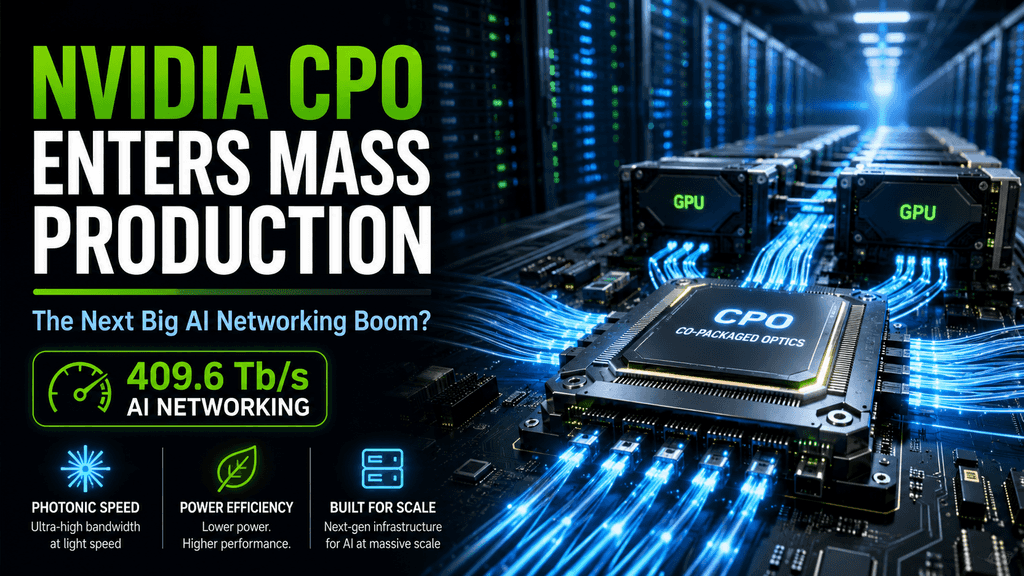
NVIDIA’s push into co-packaged optics has reached a major commercial milestone, moving CPO technology from industry demonstrations into production-ready AI networking infrastructure. As of August 2026, the company’s Spectrum-X Ethernet Photonics platform is entering real-world deployment with cloud and AI infrastructure providers, offering up to 409.6 Tb/s of switching bandwidth and a more power-efficient way to connect large GPU clusters. The development comes as artificial intelligence data centres face growing pressure from electricity limits, cooling requirements and network bottlenecks that can prevent costly accelerators from operating at full capacity. While the long-term scale of the NVIDIA CPO market will depend on manufacturing yields, supplier capacity and competition from other optical technologies, silicon photonics is emerging as one of the most important infrastructure trends supporting the next phase of AI computing. For crypto readers, this infrastructure theme also overlaps with growing interest in AI and big data tokens, although token-market performance remains separate from the commercial adoption of CPO hardware.
NVIDIA Spectrum-X CPO Enters Mass Production With 409.6 Tb/s AI Networking
NVIDIA’s Spectrum-X Ethernet Photonics platform has moved from development into commercial production, marking an important milestone for co-packaged optics, silicon photonics and next-generation AI data-centre networking. The technology is designed to connect increasingly large GPU clusters while reducing the power consumption, signal loss, heat and reliability challenges associated with conventional pluggable optical transceivers. As AI models become larger and require thousands of accelerators to operate together, networking performance is becoming just as important as raw GPU computing power.
Spectrum-X Photonics Moves Into Commercial Production
NVIDIA has confirmed that Spectrum-X Ethernet Photonics is in full production as part of its broader AI infrastructure and Vera Rubin platform strategy. The system uses co-packaged optics, commonly known as CPO, to position silicon-photonics engines close to the network-switching ASIC. This design shortens the distance that high-speed electrical signals must travel before being converted into light, helping reduce signal degradation, latency, heat generation and dependence on additional digital signal-processing components. By integrating optics directly into the switching architecture, NVIDIA aims to create faster and more energy-efficient networks for large-scale AI training, inference and agentic AI workloads, while related software developments are also expanding the role of AI agents in crypto.
The production process relies on a broad manufacturing ecosystem covering silicon-photonics fabrication, advanced semiconductor packaging, laser integration, optical testing and rack-level system assembly. TSMC supports silicon-photonics manufacturing, while SPIL, TFC Communication and Foxconn contribute packaging, laser validation and final system assembly. Early adopters include CoreWeave, Lambda and Oracle Cloud Infrastructure, providing initial commercial validation for the platform. However, the rollout remains concentrated among selected cloud and AI infrastructure partners, meaning mass production does not yet represent universal availability across the wider enterprise data-centre market.
409.6 Tb/s Bandwidth Supports Larger AI Factories
The flagship Spectrum-X Ethernet Photonics switch delivers up to 409.6 Tb/s of aggregate bandwidth, supporting as many as 512 ports operating at 800 Gb/s or 2,048 ports at 200 Gb/s. Its integrated 200G SerDes technology and co-packaged silicon-photonics engines are designed to move enormous volumes of data between GPUs with lower latency and greater energy efficiency. This capability is particularly important for modern AI factories, where network congestion can reduce GPU utilisation and leave expensive accelerators waiting for data instead of processing training or inference workloads.
NVIDIA says its latest CPO architecture can provide up to five times better networking power efficiency, longer uninterrupted AI-application runtime and faster deployment than traditional optical networking systems. These improvements could help data-centre operators connect more GPUs within fixed electricity, cooling and rack-space limits while reducing the overall power required to move data across AI clusters. Wider adoption will still depend on improvements in optical-engine manufacturing yields, silicon-photonics wafer capacity, advanced packaging availability and long-term serviceability. Pluggable optics and alternative architectures are therefore likely to remain important, but Spectrum-X entering volume production shows that co-packaged optics is becoming a practical foundation for the next generation of high-performance AI networking.
How Co-Packaged Optics Could Transform AI Data Centre Performance and Power Efficiency
The biggest advantage of co-packaged optics is not simply faster data transmission. Its real value lies in reducing the amount of electricity, cooling capacity and expensive GPU time consumed while moving information across an AI cluster. As training and inference systems grow, data movement can become a major constraint, making network efficiency increasingly important to overall AI data-centre performance.
More AI Computing From the Same Power Capacity
Traditional pluggable optical transceivers rely on relatively long electrical connections between the switch chip and the optical module. At higher transmission speeds, those connections require power-hungry digital signal processors to correct signal degradation before the data can be transmitted through fibre. NVIDIA estimates that a conventional 1.6 Tb/s transceiver could consume around 30 watts, with the DSP responsible for more than half of that power. Co-packaged optics shortens the electrical signal path from several inches to millimetres and removes the need for separate DSP retimers, allowing more of a data centre’s limited electricity supply to be directed towards GPUs rather than network signal correction. This could also reduce the heat generated by networking equipment, ease pressure on cooling systems and help operators install greater AI computing capacity within the same power envelope.
Better GPU Utilisation Through More Stable AI Networking
Large AI workloads depend on thousands of accelerators exchanging data at precisely the right time. During distributed training, a delayed connection or unstable network link can force other GPUs to wait, reducing utilisation even though the processors themselves remain fully operational. NVIDIA says Spectrum-X Ethernet Photonics is designed to provide low-jitter communication, improve collective networking performance and support more efficient mixture-of-experts model processing. The company also claims its co-packaged optical links can operate for longer periods without disruptive link flaps and provide greater network resilience than conventional Ethernet configurations. These figures remain vendor-reported, but the wider operational benefit is clear: a more stable network can reduce interrupted training runs, improve token throughput and help data-centre operators get more productive work from costly AI accelerators.
Lower Latency and Simpler Network Architecture
Moving optical engines next to the switch ASIC reduces the distance electrical signals must travel and removes several components traditionally used to clean up or retime data. NVIDIA says electrical paths in conventional transceiver-based switches may extend 14–16 inches, while its silicon-photonics design reduces that distance to less than half an inch. The shorter path can improve signal integrity and reduce latency, which becomes increasingly valuable as AI models spread work across larger clusters. CPO can also support higher connection density without continuously increasing the physical size of the switch system, helping data centres build flatter network topologies with fewer switching layers. Avoiding unnecessary layers may reduce communication delays and make it easier for GPUs to exchange data across large-scale training and inference environments.
Lower Operating Costs—But Not Without New Challenges
Co-packaged optics could reduce total networking costs by lowering power consumption, removing separate transceivers and DSPs, simplifying installation and reducing the number of active components that may fail. NVIDIA keeps more failure-prone laser sources in accessible external modules so they can be diagnosed and replaced without removing the complete switch package. However, CPO also introduces challenges involving thermal management, fibre attachment, packaging yields, interoperability and field serviceability. Standardisation and thermal-aware system design will be critical if CPO is to expand beyond early hyperscale deployments. The technology may therefore improve long-term AI data-centre efficiency, but the financial benefit will depend on equipment prices, manufacturing maturity, maintenance requirements and how effectively operators integrate photonics into existing network architectures.
NVIDIA CPO Market Outlook, Supply Chain Opportunities and Adoption Risks
The NVIDIA CPO rollout is opening a new growth layer within the AI infrastructure market. Instead of concentrating spending only on GPUs and servers, hyperscale data-centre investment is beginning to spread across optical engines, laser components, fibre connectivity, advanced packaging and photonics manufacturing. The opportunity could be substantial, but the eventual winners will depend on production scale, customer adoption, open standards and whether CPO delivers an attractive long-term cost compared with competing optical technologies.
CPO Market Growth Could Extend the AI Boom Beyond GPUs
Industry forecasts suggest that co-packaged optics could move from a small specialist market into a multibillion-dollar segment before the end of the decade. Yole Group projects that the data-centre CPO market could grow from approximately US$46 million in 2024 to US$8.1 billion by 2030, representing a compound annual growth rate of about 137%. LightCounting has separately estimated that CPO could add billions of dollars to the switch-chip market by 2030 as integrated optics become more valuable within high-speed Ethernet systems. These projections are not guarantees, but they explain why silicon photonics is attracting growing attention as AI spending spreads from processors into the networks connecting them. Initial growth is likely to remain concentrated in hyperscale AI clusters, with wider enterprise adoption developing only after production volumes rise and equipment costs become more predictable.
Lasers, Fibre and Photonics Manufacturing Create New Supply Chain Opportunities
The CPO supply chain extends well beyond the company designing the switch. High-volume deployments require external laser sources, photonic integrated circuits, optical connectors, low-loss fibre, precision assembly equipment, testing systems and materials capable of operating near powerful semiconductor packages. NVIDIA’s recent agreements show where some of that demand may develop. In March 2026, the company announced separate US$2 billion investments in Coherent and Lumentum, alongside multiyear purchase commitments and access to future production capacity for advanced laser and optical-networking components. NVIDIA and Corning later announced an official optical manufacturing partnership involving a major expansion of US optical-connectivity and fibre manufacturing. These commitments suggest the AI networking boom could create opportunities for specialised component and manufacturing companies, although participation in NVIDIA’s supply chain does not guarantee equal revenue growth or profitability for every supplier.
Vertical Integration May Become a Major Competitive Advantage
CPO production requires close coordination between switch design, photonic-chip fabrication, lasers, packaging and system-level testing, making supply-chain control increasingly important. Industry researchers expect vertical integration to become a central strategy as large technology companies seek guaranteed access to scarce optical and semiconductor capacity. NVIDIA is strengthening relationships with upstream manufacturers, while hyperscale cloud providers are using long-term procurement agreements, strategic investments and internally developed components to reduce dependence on external vendors. This trend could favour companies that control several stages of the value chain or possess difficult-to-replicate expertise in indium-phosphide lasers, silicon photonics, fibre coupling and precision packaging. It may also make entry harder for smaller suppliers because technical performance alone may not be enough without the capacity, capital and customer relationships required to support hyperscale deployments.
Pricing Cycles, Rival Technologies and Customer Concentration Remain Key Risks
A strong demand forecast does not mean CPO adoption will follow a smooth upward path. Demand for some laser and optical components currently exceeds supply, but rapid capacity expansion can eventually create excessive inventories, falling prices and cancelled duplicate orders. Co-packaged optics must also compete with improving pluggable transceivers, linear-drive pluggable optics and other architectures that may offer adequate efficiency at a lower initial cost or with easier maintenance. Broadcom is already expanding its CPO portfolio, while cloud providers may choose different networking designs based on workloads, supplier relationships and interoperability requirements. Adoption could therefore remain concentrated among a limited number of hyperscale customers, exposing suppliers to sudden changes in capital expenditure or platform strategy. Crypto readers should also distinguish this hardware cycle from AI-powered crypto trading, which involves algorithmic market tools rather than data-centre networking equipment. The strongest long-term signals will be repeat orders, improving manufacturing economics, wider customer deployment and evidence that CPO remains competitive after current component shortages begin to ease.
|
KuCoin is celebrating its 9th anniversary with a special platform campaign filled with exclusive rewards, trading activities, and limited-time offers. Don’t miss the chance to participate and enjoy the benefits as the exchange marks nine years of growth and innovation. Visit the official campaign page now:
|

Conclusion
NVIDIA Spectrum-X CPO entering production represents an important turning point for silicon photonics and AI data-centre networking. The technology addresses a growing infrastructure problem: faster GPUs alone cannot deliver efficient AI computing when networks consume too much power, introduce delays or fail to keep thousands of accelerators synchronised. By moving optical engines closer to switching silicon, co-packaged optics could improve bandwidth density, reduce networking power requirements and help cloud providers extract more useful computing performance from expensive AI clusters. The long-term outlook remains promising but uncertain. Strong AI infrastructure spending, expanding optical supply chains and rising demand for high-speed Ethernet create favourable conditions for the NVIDIA CPO market, yet manufacturing yields, packaging capacity, costs and competing technologies will determine how quickly adoption spreads. CPO is unlikely to replace every pluggable optical system in the near term, but its move into commercial production shows that silicon photonics is becoming a serious part of the architecture behind next-generation AI factories.
Frequently Asked Questions
What does CPO stand for in AI networking?
CPO stands for co-packaged optics, a network design that places optical components close to the switch processor rather than inside removable transceiver modules at the front of the switch. This reduces the distance high-speed electrical signals must travel before being converted into light.
Is NVIDIA the first company to develop co-packaged optics?
No. Broadcom and several optical-networking companies have worked on CPO systems for years. NVIDIA’s importance comes from combining co-packaged optics with its GPUs, networking chips, software and AI infrastructure platforms, giving it greater control over the complete data-centre architecture.
Will CPO replace all pluggable optical transceivers?
A complete replacement is unlikely in the near term. CPO is currently best suited to very large AI clusters where bandwidth density and power consumption are critical. Traditional pluggable optics may remain more practical for smaller data centres because they are easier to replace, upgrade and maintain.
What is the difference between CPO and linear-drive pluggable optics?
CPO moves the optical engines next to the switching silicon, while linear-drive pluggable optics keep removable transceiver modules at the front of the switch but reduce their power use by removing or simplifying digital signal processors. Linear-drive optics may offer easier maintenance, while CPO can deliver greater efficiency at very high network speeds.
Why are external lasers used in some CPO systems?
Keeping laser sources outside the main switch package can reduce thermal stress and make faulty lasers easier to replace. The optical engines remain close to the switching chip, while the external laser module supplies the light needed to carry data through fibre connections.
Could CPO reduce the total cost of running an AI data centre?
It could lower operating expenses by reducing networking power consumption, cooling requirements and the number of signal-processing components. However, initial equipment prices, installation complexity and maintenance costs may remain high until production volumes increase and industry standards become more established.
Disclaimer: This article is for informational purposes only and does not constitute investment advice. Market forecasts, company plans and technology adoption may change, so readers should conduct their own research before making financial decisions.